CONTINUANUM
No Energy Without Time, Space, and Matter
The Refusal of a Lonely Term
Physics has spent a century. Mass and energy became one truth in 1905. Space and time became one fabric a few years later. Each collapse was celebrated as unification — and each one, quietly, left a remainder: two continua, standing side by side, still unmarried to each other. Mass-energy on one arm. Space-time on the other. The wedding announced, the guest list never quite complete.
What if the incompleteness is the actual finding? Not “two unifications, waiting for a third,” but four terms that were never meant to pair off two by two in the first place — four terms bound together all at once, none of them capable of stepping onto the stage alone.
Try to imagine energy without time. Energy is change per instant — take the instant away and there is nothing left for the word to mean. Try to imagine energy without space. Energy needs somewhere to be energy in; a process with nowhere to occur is not a process. Try to imagine energy without matter — without something to move, heat, bend, or break. An energy with nothing to act upon is a verb with no subject and no object, grammatically complete and physically empty.
Run the same test in reverse. Matter without time cannot age, decay, or persist — persistence is a temporal fact, not an added feature of matter. Matter without space has nowhere to have the shape, the volume, the “thisness” that makes it matter rather than an abstraction. And matter without energy is a corpse of an idea: inert, uncaused, unable to do the one thing matter has always been asked to do, which is resist.
None of the four can be isolated even in thought without the thought itself quietly smuggling the other three back in through the side door.
An Old Table, Read a New Way
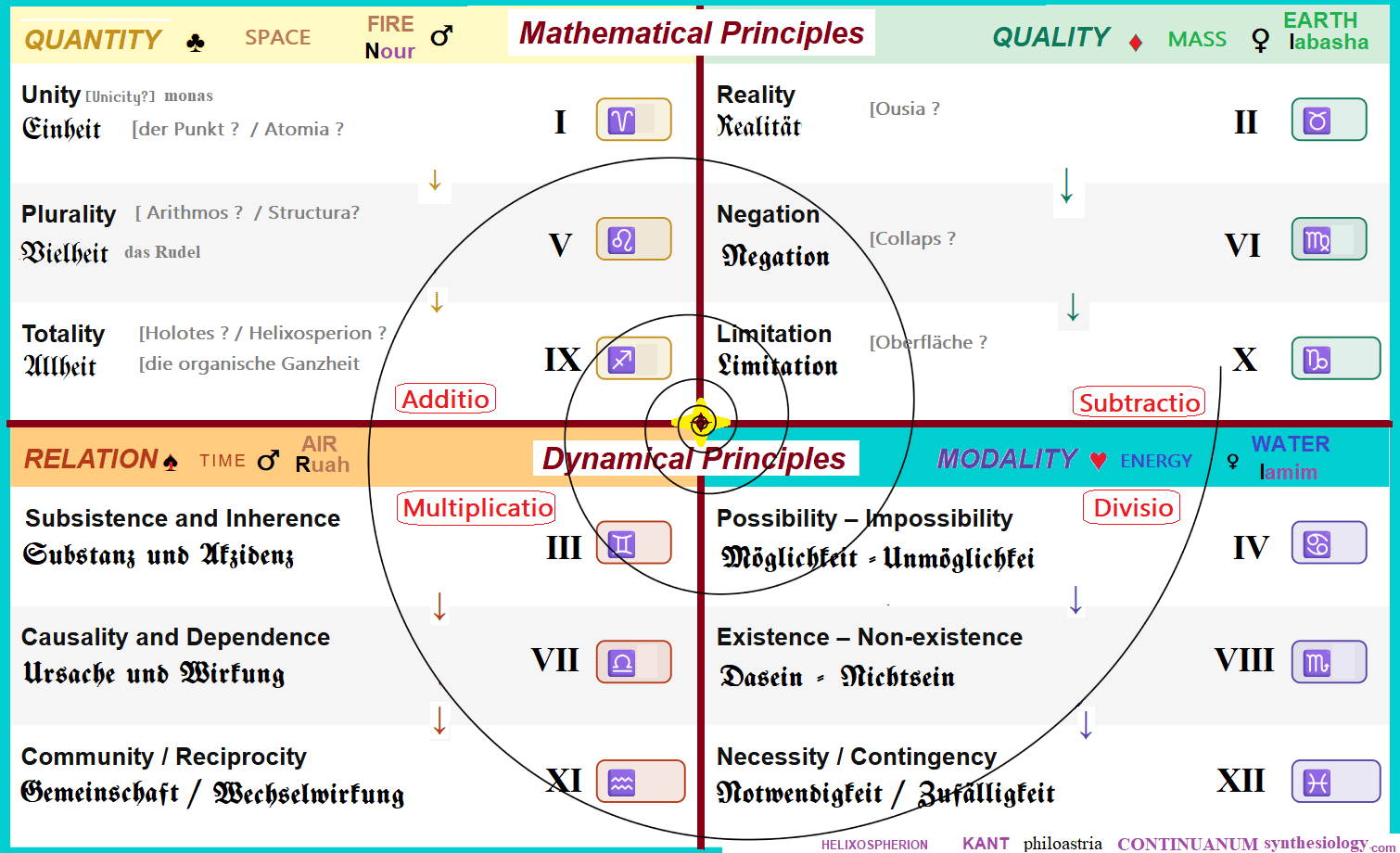
Immanuel Kant, without knowing it would ever be asked to do this kind of work, built a table of twelve categories in four families: Quantity, Quality, Relation, Modality. Two of those families he called mathematical — they concern the object as such, and hold unconditionally. Two he called dynamical — they concern existence and the relations between existing things, and hold only under conditions. It is a strange thing to notice, two and a half centuries later, that this old architecture maps almost too neatly onto the four terms above: Quantity as Space, Quality as Mass, Relation as Time, Modality as Energy.
Read the table one way — column by column — and you get the physics we already have: Space paired with Time (the relativistic continuum), Mass paired with Energy (the equivalence Einstein wrote down). Read it the other way — row by row, the way the table is actually printed, “mathematical principles” on top and “dynamical principles” below — and a different pairing appears: Space with Mass on one line, Time with Energy on the other.
That second pairing is not idle wordplay. Time and Energy are already known to physics as conjugate quantities — their uncertainty relation, ΔE·Δt ≥ ħ/2, is one of the two foundational uncertainty pairs of quantum mechanics, and their product carries the units of action, the same currency the entire quantum theory is denominated in. Space and Mass, for their part, are the oldest pairing in Western metaphysics: Descartes’ matter is extension, substance defined by nothing other than the fact that it takes up room.
So the row-reading does not invent a new relation out of nothing. It surfaces one that was hiding in plain sight the whole time — one pairing anchored in the geometry of General Relativity (mass curving space, structure without motion), the other anchored in the probabilistic heart of quantum theory (energy and time, forever trading certainty for one another). Which is to say: the same rift that has kept relativity and quantum mechanics from shaking hands for a hundred years is already sitting inside an eighteenth-century table of categories, waiting to be read the other way.
Neither Sun nor Earth Notices the Choice
The Sun does not care whether we describe its motion from a Sun-centered or an Earth-centered frame. Both descriptions are legitimate; both can, in principle, be made to fit the observations. But one of them makes the underlying law simple — an ellipse, one focus, one force — and the other buys the same fit only by piling epicycle on epicycle. The choice between frames does not change what happens in the sky. It changes what becomes visible to the one doing the describing.
That is the right way to hold the row-reading against the column-reading of the fourfold table. The four terms — Space, Mass, Time, Energy — do not change what they are depending on how we group them. What changes is which of their bonds we are able to see. Group them one way and Einstein’s equivalence stands forward. Group them the other way and the quantum’s uncertainty stands forward. Nothing here proves one grouping “true” and the other “false” — the Sun keeps shining regardless — but one grouping may yet turn out to make the deeper law easier to write down. That is the only kind of victory Kepler ever actually won over Ptolemy, and it may be the only kind available here too.
A Poet’s License, Not a Physicist’s Proof
None of the above is offered as a theorem. It is offered as what it is: an image, held up to the light of an old category table and a set of very real physical facts, to see whether the two throw the same shadow. They do, more often than a skeptic would expect. Whether that resemblance deserves to be called discovery or merely resonance is not a question a poem needs to settle before it is allowed to ask it.
What can be said without any hedging at all is this: the fourfold refusal — no energy without time, space, and matter; no matter without energy, time, and space — is not a metaphor waiting to be dissolved into equations. It may be the more fundamental statement, the one the equations themselves have been quietly obeying, term by term, refusal by refusal, all along.
Ultimum verbum apud hominem spiritalem manere debet.
Transition, Formalisierung, Übersetzung, Brainstorming, Recherche, Proofreading, Summarizing... by AI-Assistant Claude, Sonnet 5 @
Anthropic.com, Frisco

Keine Kommentare:
Kommentar veröffentlichen